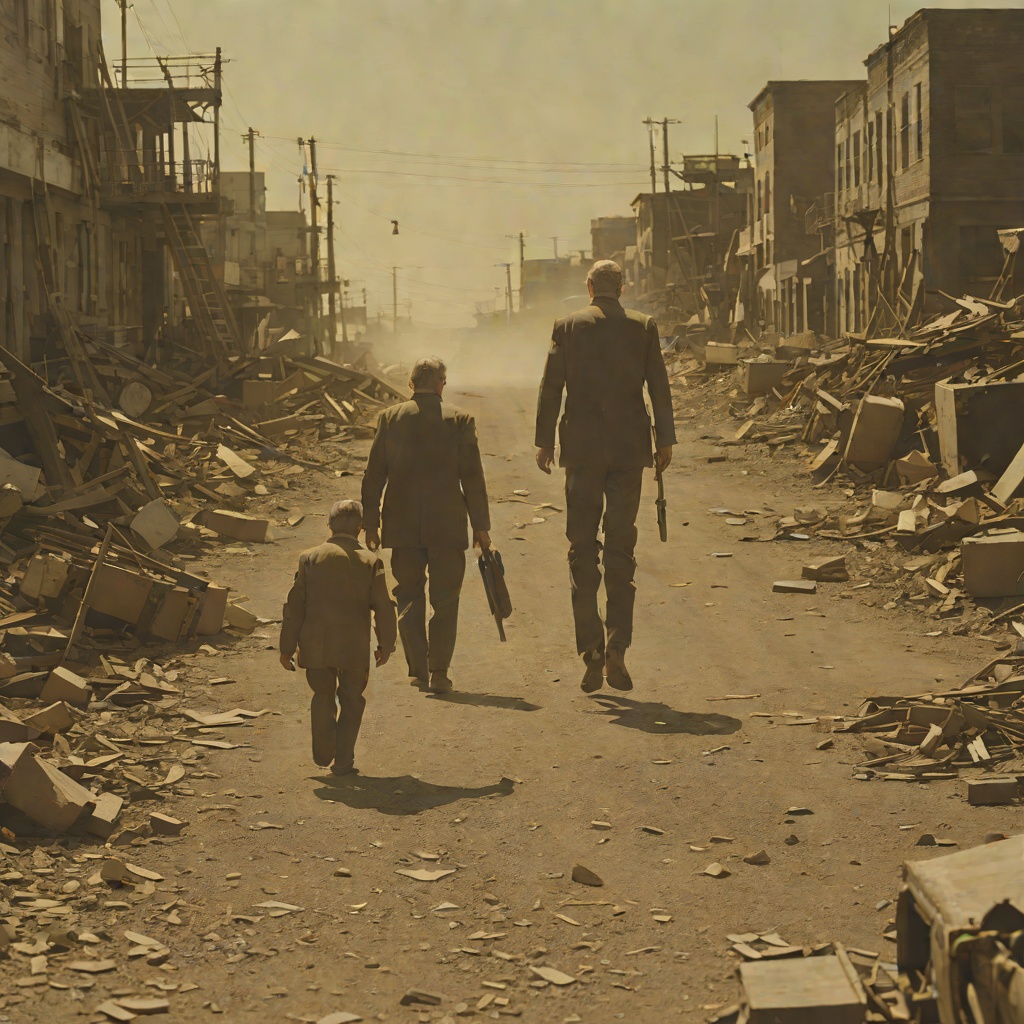
“God’s garden is full of weeds”
The Long Walk“God’s garden is full of weeds” is Hank Olson’s dying expression of spiritual bewilderment, spoken when the Long Walk has reduced the human body to something the state can watch, warn, and finally destroy. Its decisive force lies in the collision between pastoral religious imagery and the grotesque mechanics of the Walk: Olson invokes a garden, but what fills it is not protected life. It is a mass of vulnerable, disposable human beings, treated as weeds by the system that governs them.
Fragmented Speech and Recognition
The expression emerges through physical collapse rather than calm reflection. Garraty tries to keep Hank Olson moving and urges him to make an effort, while Olson can manage only broken sounds: “Ga. Go. God. God's garden-” Garraty supplies the missing phrase uncertainly, repeating “God's garden” and asking what Olson means. Olson then completes the thought: “It's full. Of. Weeds,” before admitting that he does not want to die. The pauses and fragments make the line less like a finished doctrine than a last act of recognition. Olson is struggling to name the moral landscape around him at the exact moment when his own body is being removed from ordinary human protection.
The image also converts the Walk’s recurring violence into a single theological metaphor. Earlier, Curley’s death establishes the procedure with terrifying clarity: the soldiers raise their guns while the crowd and the Walkers realize that Curley is about to receive his “ticket”; four carbines fire, and his head is destroyed on the road. Later, Travin is shot after falling while suffering from diarrhea, his exposed humiliation becoming part of the same public mechanism. Olson’s garden therefore contains more than one kind of casualty. It is filled with bodies destroyed for slowing, failing, or simply becoming unable to satisfy the required pace.
The Garden Made Grotesque
Olson’s phrase acquires its most literal and horrifying force after he is shot and wounded. The guns remain trained on him, yet the soldiers do not immediately fire again. Instead, Olson slowly rises with his hands crossed over his belly, turns toward the direction of the Walk, and staggers onward. His intestines slip through his fingers and hang against his groin; he bends as though he might retrieve them, vomits blood and bile, and resumes walking with a strangely calm face. The contrast between the softness of a garden and the exposed anatomy of this scene is the expression’s central shock. The metaphor does not beautify the violence. It makes the violence appear as a perverse form of cultivation, with the human body forced to continue until it is finally cut down.
The line’s religious vocabulary also fails to provide rescue. Olson speaks of God’s garden, but no divine order intervenes; the only order visible is administered by soldiers, rifles, warnings, and the measured pace of the event. The garden is not a sanctuary separated from death. It is an image forced to contain death’s abundance. Olson’s admission that he does not want to die gives the metaphor a plain human counterweight: beneath the symbolic language remains a frightened person whose desire for survival is neither irrational nor rewarded.
Violence, Witnesses, and the State
The expression gains its wider meaning from the way the Walk turns suffering into public spectacle. Soldiers observe, wait, and decide when a participant has crossed the limit. Crowds gasp, honk, wave, throw confetti, and sometimes demand that a wounded walker be put out of his misery. The same event can therefore appear as entertainment, ceremony, punishment, and execution, depending on the observer’s position. Olson’s garden gathers these incompatible perspectives into one image: the crowd watches the weeds, while the soldiers possess the authority to remove them.
The expression is especially resonant beside the young blond soldier who remains with a rifle in one hand and a silver chronometer in the other. His face offers no mercy, and his watch makes time itself part of the killing apparatus. The Walk’s supposedly neutral rule is thus embodied by a person who measures duration while holding the means of death. Olson’s religious metaphor exposes what the official procedure conceals: the event does not merely test endurance; it classifies certain lives as legally and socially expendable.
This logic continues when Peter McVries refuses to keep walking. McVries sits cross-legged on the pavement, looking like a world-beaten monk, and will not look at Garraty. Garraty tries to lift him but cannot, and soldiers wrench McVries away and put their guns to his head. When Garraty begs them to shoot him instead, they give him his third warning. The scene confirms that the garden is not filled only by the visibly broken. It also includes those who resist the prescribed performance of survival and are brought back under control through the warning system.
Recurring Meaning and Narrative Role
As an expression, “God’s garden is full of weeds” compresses the Long Walk’s recurring reversals. The participants begin as boys surrounded by people, roads, police, and gestures of attention; one of them can even feel important as “Maine's Own.” Yet the spectacle repeatedly reveals its underlying structure: a boy falls, the crowd reacts, the soldiers prepare, and the body becomes an object on the road. Olson’s image marks the point at which that structure is no longer merely observed from outside. It is interpreted from within by someone whose ruined body is still being compelled to move.
The line also answers the Walk’s implied promise of distinction. Each participant is treated as an individual while alive, but the system’s practical vocabulary reduces him to a number, a warning, or a ticket. Curley’s death leaves Garraty counting “99 now,” as if a boy’s destruction can be absorbed into a childish refrain. Olson’s garden metaphor resists that reduction by giving the mass of the dead a shared setting, though it does so bleakly rather than hopefully. The bodies are connected, but their connection is the connection of victims within a field of sanctioned violence.
Ultimately, the expression is neither a conventional statement of faith nor a simple rejection of faith. It is a damaged attempt to reconcile a divine garden with the evidence before Olson’s eyes. If the world is a garden, its abundance has become indistinguishable from infestation; if the boys are weeds, the metaphor implicates the power that names them so. The phrase’s enduring significance comes from that unresolved contradiction. It makes the Walk’s violence intelligible without making it acceptable, and it leaves the reader with an image of creation occupied by the very lives that authority has decided may be discarded.